Designing a New Generation
TECHNOLOGY
Techniques are still being perfected through experiments on plants and animals, and as scientists continue to uncover the secrets of the human genome, they are progressing towards this tempting, futuristic world.
In Vitro Fertilization (IVF)
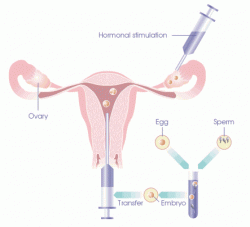
In Vitro Fertilization (IVF) is a form of assisted reproductive technology (ART) used to help a woman become pregnant. It is the process of fertilization by manually combining an egg and sperm in a petri dish in a laboratory.
There are five basic steps in the IVF and embryo transfer process:
-
Monitor and stimulate the development of healthy egg(s) in the ovaries.
-
Collect the eggs.
-
Secure the sperm.
-
Combine the eggs and sperm together in the laboratory and provide the appropriate environment for fertilization and early embryo growth.
-
Transfer embryos into the uterus.

Preimplantation Gentetic Diagnosis (PGD)
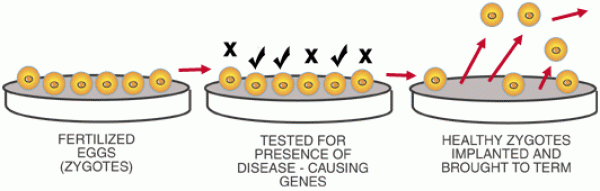
Preimplantation genetic diagnosis (PGD) is a screening test used to determine if genetic or chromosomal disorders are present in embryos produced through in vitro fertilization (IVF). One or two cells are removed from an embryo and checked for genetic and/or choromosomal defects. After it is screened, a doctor is able to tell what physical characteristics that child will have; along with any genetic diseases. Only "clean" embryos that are unaffected by the genetic or chromosomal disorder are introduced to the woman's womb.
Preimplantation genetic diagnosis involves the following steps:
-
First, one or two cells are removed from the embryo.
-
The cells are then evaluated to determine if the inheritance of a problematic gene is present in the embryo.
-
Once the PGD procedure has been performed and embryos free of genetic problems have been identified, the embryo will be placed back in the uterus, and implantation will be attempted.
-
Any additional embryos that are free of genetic problems may be frozen for later use while embryos with the problematic gene are destroyed.


"It is important to remember that this testing is being done on only one or two cells. The amount of DNA available for testing is therefore very limited and testing for only one type of genetic disorder is possible per embryo. For example, testing for abnormal chromosomes cannot be combined with testing for a specific genetic disorder, such as cystic fibrosis (CF). In addition, because the testing is only done on one or two cells from a single embryo, there is a possibility that the cells tested do not accurately represent the status of the entire embryo. Studies have shown that PGS is usually about 85% accurate, with the potential for both false-positive or false-negative results. This is why “diagnosis” in PGD was changed to “screening”. "